In brief
Three ideas to carry into playtime
Movement and contrast can redirect a toddler’s focus in the moment.
A familiar toy can become a cue: the brain starts expecting what may happen next.
Small surprises help children update their expectations through everyday play.
A small moment while playing with a child can sometimes reveal something surprisingly deep about how the brain works.
Imagine this:
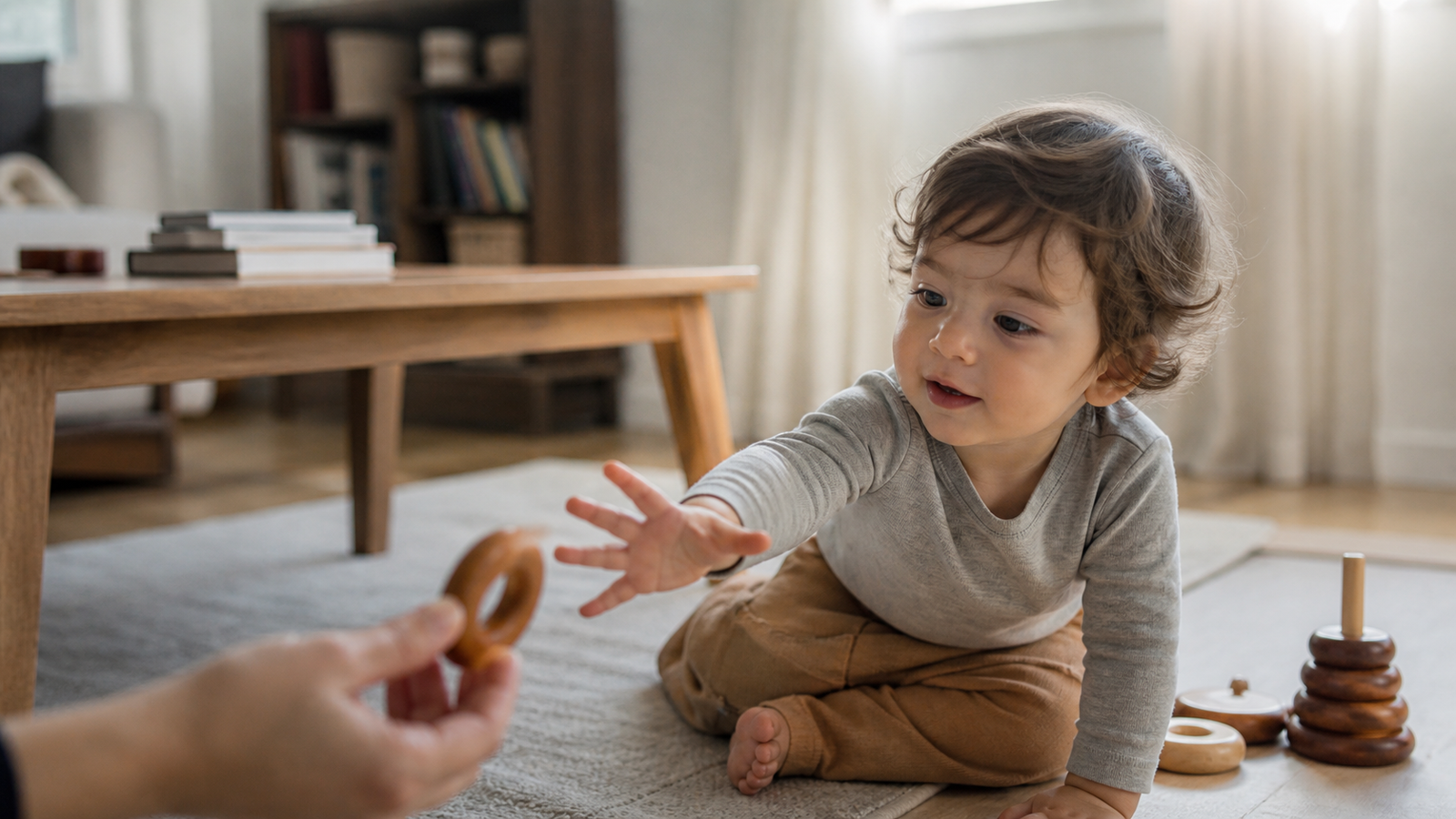
A toddler is crying. You pick up a toy and start moving it around. Almost immediately, her attention shifts. She stops focusing on whatever was upsetting her and watches the toy. Nothing particularly surprising so far. But then you stop moving the toy. And she keeps staring at it.
For several seconds, nothing happens. The toy is completely stationary, yet her eyes remain fixed on it—as though she is waiting for something.
Is she expecting it to move again?
If so, that simple moment touches on some of the most interesting ideas in modern neuroscience: attention, prediction, dopamine, reward prediction errors and the way developing brains learn about the world.
It also raises another question:
Could dopamine—or a lack of it—be related to why young children become distressed or worried?
The answer is more complicated than “low dopamine causes worry.” But exploring why reveals something much more interesting about the brain.
Your Child’s Brain Isn’t Just Reacting to the World

It’s tempting to imagine perception working like a camera. Something happens in the environment, the eyes detect it, the information reaches the brain, and then the brain responds. But many neuroscientists think perception involves something more dynamic.
One influential framework, called predictive processing, proposes that the brain continuously uses previous experience to generate expectations about incoming sensory information. It then compares those expectations with what actually happens.
In simplified form:
Prediction → sensory input → comparison → update
For example:
You see someone raising a glass toward their mouth. Before the glass reaches their lips, your brain already has a good idea of what is likely to happen next. Or you watch a ball rolling toward the edge of a table. You don’t need to wait until it falls to understand what’s probably coming. Our brains constantly use patterns from the past to anticipate the immediate future.
Predictive-processing theories have become highly influential in neuroscience, although researchers continue to debate exactly how broadly they apply and how prediction-error signals are implemented in different neural circuits. (PubMed)
For a young child, however, there is an additional challenge:
Almost everything is new.
A toddler’s brain is still building models of objects, people, movement, sounds, cause and effect, timing and social interactions. Play provides enormous amounts of data for constructing those models.
Why Did the Moving Toy Capture Her Attention?
Before we even get to dopamine, there is a simpler process involved: attention.
Movement is powerful sensory information.
Early visual attention depends on several interacting systems, including mechanisms involved in alertness, orienting toward something, selecting information and eventually exerting more voluntary control over attention. (Annual Reviews)
In very young infants, visual orienting is particularly influenced by conspicuous sensory information such as motion and contrast. As development progresses, attention becomes increasingly influenced by experience, motivation and goals. (DOI)
So when a moving toy suddenly appears while a child is crying, something roughly like this can occur:
Distress → moving object appears → visual salience increases → attention reorients
The toy effectively wins the competition for attention. That alone can temporarily interrupt crying. This doesn’t necessarily mean that the toy gave the child a “dopamine hit” that fixed her emotional state. It may simply have introduced a sufficiently strong and interesting signal for the brain to prioritize something else.
But what happens after the toy stops moving is arguably more interesting.
Why Keep Looking at a Toy That Has Stopped Moving?
Suppose you move the toy several times.
The child’s brain repeatedly experiences:
Toy present → movement happens
After enough experience—even over a short period—the stationary toy may no longer represent only what is happening right now.
It may contain information about what is likely to happen next.
In other words:
Seeing the toy may become a cue predicting movement.
So when you suddenly stop moving it, the child may continue watching because her brain has formed an expectation:
“Something is probably about to happen.”
We cannot determine exactly what a toddler is predicting simply from their gaze, and staring by itself cannot tell us that dopamine was released. But the general phenomenon—previous events shaping expectations about future events—is fundamental to learning.
You can think of the brain as estimating something like:
Probability of movement soon, given that this toy is here
The toy has become informative even while it is stationary. That’s an important distinction.
Attention doesn’t have to be driven only by what an object is doing. It can also be driven by what the brain thinks the object is about to do.
So Where Does Dopamine Enter the Story?
Dopamine is frequently described as the brain’s “pleasure chemical.” That’s an oversimplification. Dopamine is involved in several processes, including motivation, action selection, learning, movement and deciding which outcomes are worth pursuing.
One particularly important role involves reward prediction errors.
Certain populations of dopamine neurons in midbrain regions such as the ventral tegmental area and substantia nigra can change their activity depending on the difference between an expected reward and what actually occurs.
Very roughly:
Better than expected → positive prediction error
About as expected → little prediction error
Worse than expected → negative prediction error
Research on dopamine reward-prediction-error signaling has shown that dopamine responses are not simply equivalent to pleasure. They can function as teaching signals that help update expectations about valuable outcomes. (PubMed Central (PMC))
A simplified reinforcement-learning equation sometimes used to describe this idea is:
δ = r + γV(s′) − V(s)
Don’t worry about the mathematics.
Conceptually, it means:
Prediction error = what happened compared with what the brain expected to happen.
That difference can help the nervous system learn.
The Surprise Is Where Learning Gets Interesting

Return to the toy.
Imagine this pattern:
Move → stop → move → stop → move → stop
Eventually, the pauses themselves may become meaningful. The child doesn’t necessarily interpret the pause as “nothing.”
It could become:
“This is the part before it moves again.”
Now change the pattern.
Move → stop → wait…
And keep waiting. The expected movement doesn’t happen. There is now a mismatch between expectation and reality.
That mismatch is a prediction error.
The child might stare longer. She might move her eyes. She might reach toward the toy. She might vocalize. Eventually, she might lose interest.
Those behaviors alone don’t prove which neural mechanism is responsible, but the underlying principle is extremely important:
When reality differs from expectation, the brain receives information that can be used to update its model of the world.
This is why surprise can be such a powerful ingredient in learning.
The Reward Can Move From the Event to the Cue
One of the fascinating discoveries from classical conditioning and reinforcement learning is that, as learning develops, neural responses can shift toward things that predict an important outcome.
Imagine that something enjoyable happens unpredictably. Initially, the outcome itself is the surprising event. But if a particular sound consistently occurs just before it, the sound becomes meaningful.
Eventually:
Cue → expectation → outcome
The cue has acquired predictive value. This helps explain why anticipation itself can be so powerful. Think about adults. A notification sound can immediately make you want to check your phone. The notification hasn’t given you anything yet.
But your brain has learned:
Sound → potentially interesting information incoming
The prediction can influence behaviour before the reward arrives. The same general learning principle operates throughout life, although children’s developing brains and adult smartphone habits obviously shouldn’t be treated as identical situations.
Does That Mean Low Dopamine Causes Worry in Toddlers?
Probably not. This is where an attractive explanation can become misleading if we push it too far.
It would be tempting to describe the original observation as:
Low dopamine → child feels bad → moving toy increases dopamine → child feels better
But emotional distress doesn’t work through a single neurotransmitter. A toddler may cry because of hunger, fatigue, discomfort, pain, frustration, separation, overstimulation, boredom, fear or dozens of other reasons.
These states involve interacting systems across the brain and body, including autonomic regulation, stress hormones and neural systems involving dopamine, noradrenaline, serotonin and many other signaling molecules.
So it isn’t useful to think:
Worry = not enough dopamine.
There is, however, a more interesting connection between distress and uncertainty.
Uncertainty Can Make the Brain Pay Attention
From a survival perspective, uncertainty matters. A predictable environment is relatively easy to navigate. An unpredictable environment may require more monitoring. Imagine hearing a mysterious noise somewhere in your house at night.
You don’t immediately know:
- what caused it,
- where it came from,
- whether it will happen again,
- or whether it matters.
Your attention increases. You start listening. Uncertainty can therefore contribute to vigilance and arousal.
A more useful conceptual model is:
Uncertainty → increased monitoring/arousal → information gathering
rather than:
Low dopamine → worry
Dopamine can interact with these processes because it helps the brain learn which cues predict outcomes worth approaching or responding to. But worry, fear and emotional regulation involve much broader neural systems.
A Toddler’s Life Is Essentially One Giant Prediction Experiment
Think about how much a young child has to discover. If I drop this object, will it fall? If I push this button, will a sound happen? If Dad hides behind his hands, will his face come back? If I roll this ball, where will it go? If I make this sound, will someone respond? If I put this shape here, will it fit? Adults already possess internal models for thousands of these events. Toddlers are constructing them.
That makes ordinary play remarkably powerful. Consider peek-a-boo.
At first:
Face disappears.
Then:
Face reappears.
After repetition:
Face disappears → child expects face to return
Now pause slightly longer than usual. Suddenly there is uncertainty. Then—
Peek-a-boo!
Prediction, anticipation, surprise and updating have all occurred within a few seconds. No expensive “brain-training” technology was required.
Cause-and-Effect Play Is a Natural Learning Laboratory
This provides a useful way to think about toys.
Instead of asking:
“Which toy gives my child the most stimulation?”
A better question might be:
“Which toys let my child discover relationships between actions and outcomes?”
Some of the simplest toys can be excellent for this.
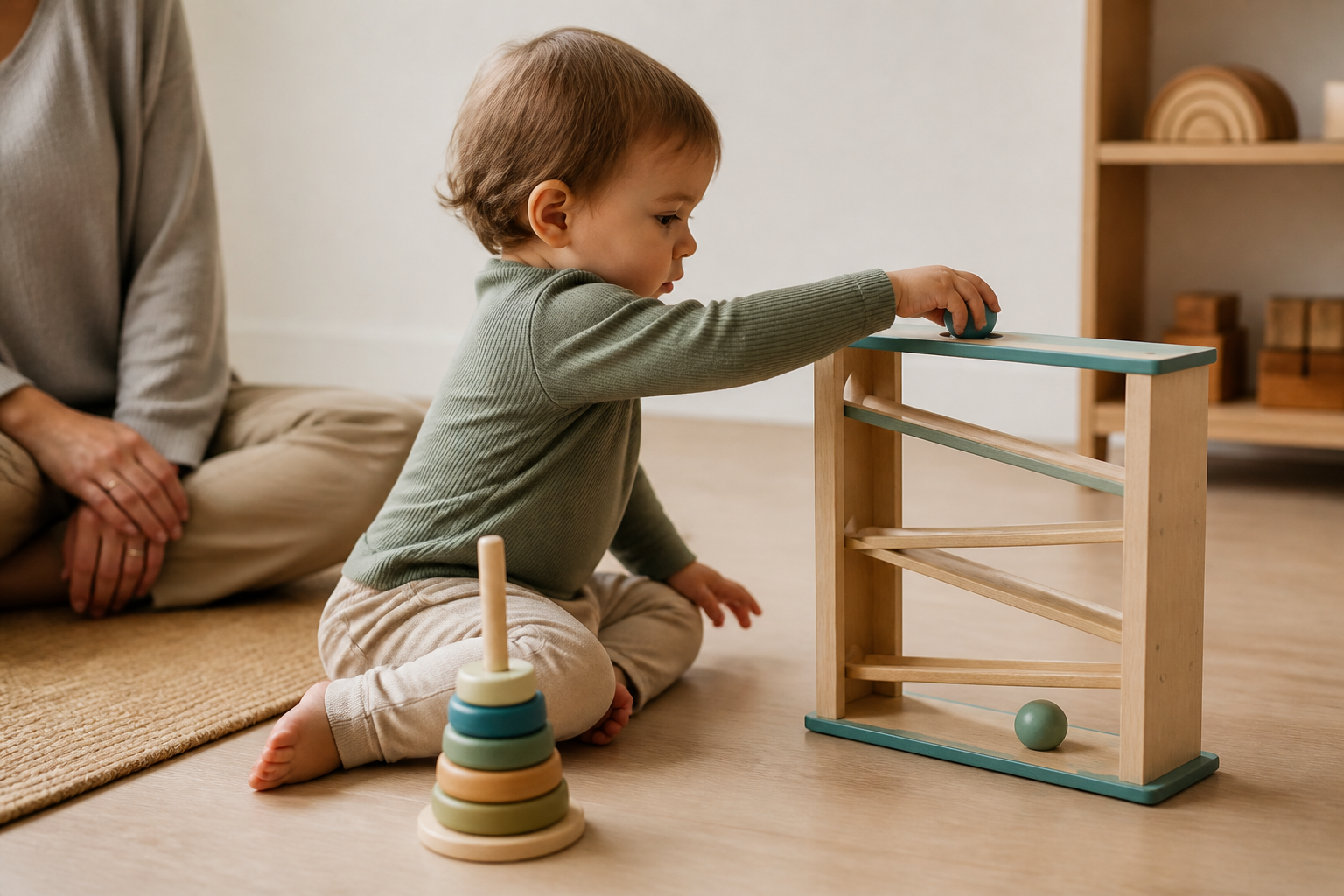
Ball ramps
Release ball → ball rolls → ball appears somewhere else. The sequence is visible and repeatable.
Pop-up toys
Press, rotate or pull something → another object suddenly appears.
Object-permanence boxes
Object goes inside → temporarily disappears → appears elsewhere.
Stacking and nesting toys
Different actions produce different physical outcomes.
Simple musical toys
Action → predictable sound.
Rolling or pull-back vehicles
Force → movement → slowing → stopping.
Activity boards
Switch → response. Door → open. Gear → movement. Slider → change. The important feature isn’t that these toys “boost dopamine.” That would be an exaggerated and poorly supported claim.
Their value is simpler:
They provide repeatable opportunities for children to act, predict, observe and update.
A Simple Play Idea: Prediction Pauses
You can even create these learning moments without buying anything. Take something your child already enjoys.
Move it several times using roughly the same rhythm:
move → pause → move → pause → move
Then make one pause slightly longer. Watch what your child does. Do the eyes remain fixed? Do they look toward you? Does the child reach? Do they smile when the movement finally occurs? You haven’t performed a neurological experiment, and you shouldn’t interpret individual behaviours diagnostically.
You’re simply giving the child an opportunity to experience:
pattern → expectation → variation → outcome
You can do the same thing with songs. Sing a familiar sequence and pause before the final word. Or play peek-a-boo and vary the timing. Or roll a ball back and forth and occasionally wait before returning it. The goal isn’t maximum stimulation.
The interesting part is participation, expectation and discovery.
Don’t Try to “Maximize Dopamine”
Once people learn that dopamine is involved in motivation and learning, there’s a temptation to optimize everything around it. That’s unnecessary—especially with children. A developing brain doesn’t need a constant stream of spectacular stimulation.
Ordinary life already contains enormous amounts of novelty:
faces, voices, objects, textures, gravity, movement, sounds, social responses and physical consequences. And because prediction depends on patterns, endless novelty isn’t necessarily better. Repetition matters too.
A child may repeat the same action dozens of times because repetition allows the brain to test:
“Does the same thing happen again?”
What looks boring to an adult may actually be useful information to a developing brain.
The Most Interesting Part Wasn’t the Moving Toy
The obvious moment in this story was when a moving toy stopped the crying. But from a cognition perspective, the more interesting moment may have happened afterward.
The toy stopped moving—and the child kept looking.
Nothing was happening externally. Yet something may still have been happening internally. The brain had recently experienced a pattern. It had information from the past. It may have been preparing for what came next. And when reality eventually matched—or failed to match—that expectation, the nervous system gained another tiny piece of information about how the world works.
This happens thousands of times during childhood. Look. Predict. Act. Wait. Be surprised. Update. Try again. Perhaps one of the most useful ways to understand early learning is not to imagine a child’s brain as an empty container that adults need to fill with information.
Instead, think of it as an extraordinarily active prediction machine—continually experimenting with the environment and asking:
“What happens next?”
Toys That Encourage Cause-and-Effect Exploration
Disclosure: This section may contain affiliate links. If you purchase through one of these links, the site may earn a commission at no additional cost to you.
If you’re looking for toys that complement this kind of play, focus less on products marketed as “brain boosters” and more on toys that give children clear, repeatable relationships between their actions and what happens next.
Good categories to explore include:
- Ball-drop and ball-ramp toys
- Pop-up cause-and-effect toys
- Object-permanence boxes
- Stacking and nesting toys
- Simple shape sorters
- Push-and-go or rolling vehicles
- Simple musical cause-and-effect toys
- Activity boards with switches, sliders, gears and doors
The goal isn’t to create bigger dopamine spikes.
It’s to create opportunities for:
action → prediction → outcome → learning
And often, the simplest toy does that beautifully.
Sources and Further Reading
Wolfram Schultz — “Dopamine reward prediction-error signalling: a two-component response.” Nature Reviews Neuroscience, 2016. A detailed review of how dopamine neurons can signal differences between predicted and received rewards. (PubMed Central (PMC))
Shohei Furutachi & Sonja B. Hofer — “Rethinking Predictive Processing.” Annual Review of Neuroscience, 2026. A modern review examining both the evidence for predictive processing and important limitations of the framework. (Annual Reviews)
John Colombo — “The Development of Visual Attention in Infancy.” Annual Review of Psychology, 2001. A foundational review of alertness, orienting and other components of visual attention during infancy. (Annual Reviews)
Samuel V. Wass and colleagues’ broader field of developmental attention research has continued to show that visual attention is multifaceted and changes substantially across early development; attention should not be interpreted through any single behavioural measure. (Annual Reviews)
Key takeaway: A toddler waiting for a toy to move again doesn’t prove that we’re watching dopamine in action. But it offers a beautiful illustration of a more fundamental idea: developing brains are constantly using past experience to anticipate what might happen next.
Explore related learning: Predictive coding and learning from error.