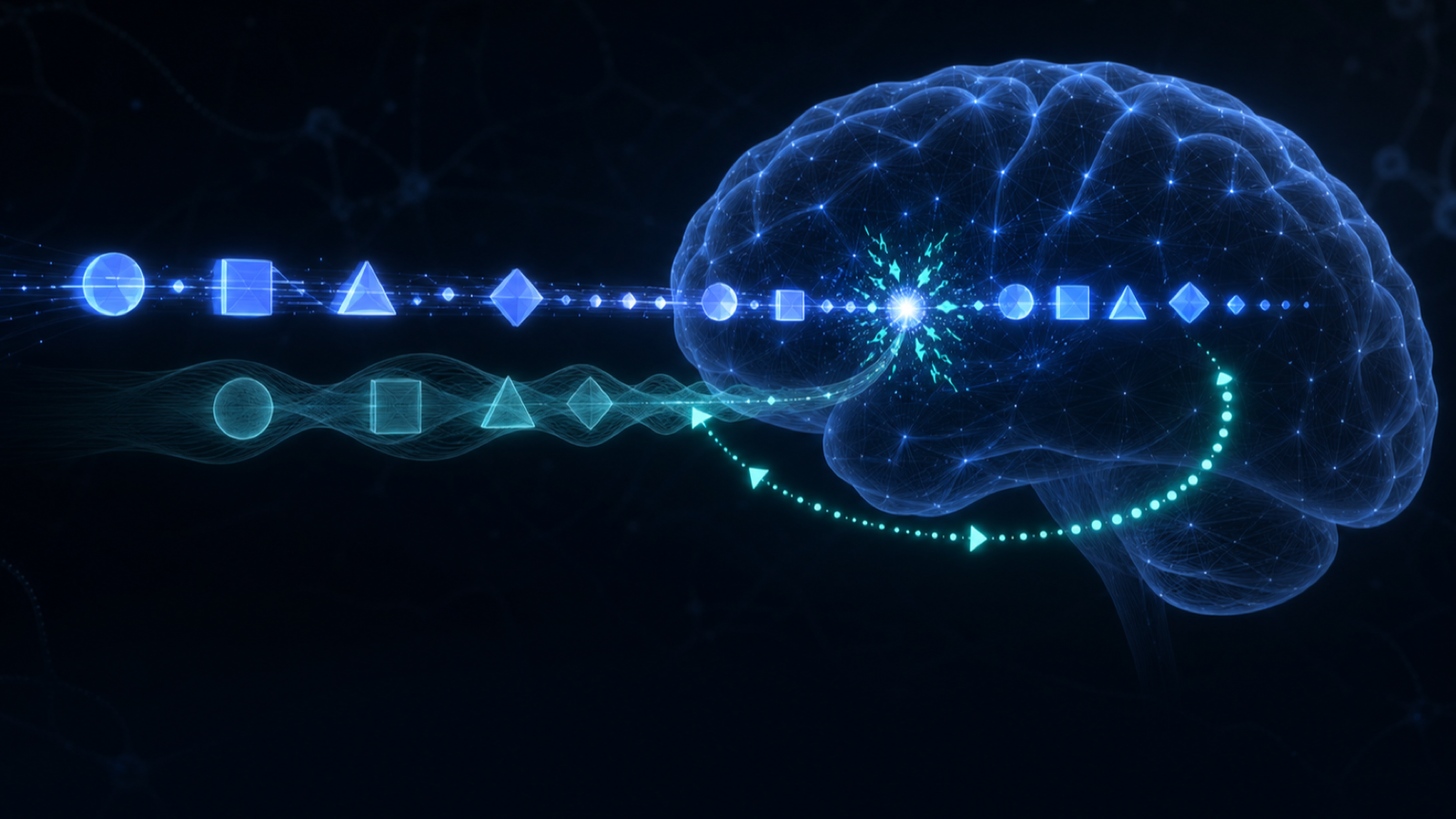
Your brain does not wait passively for the world to explain itself. It uses past experience and the present context to anticipate what is likely to happen next, compares that expectation with incoming information, and learns from the difference.
This influential idea is called predictive coding, or more broadly predictive processing. It can offer a useful way to think about perception, attention, and learning. It is not, however, a proven self-help system or a complete account of how every part of the brain works.
Predictive coding in plain language
Imagine reaching for a mug that looks full. Before you lift it, your brain has already prepared for an expected weight. If the mug is empty, your hand rises faster than planned. That mismatch is a prediction error: the difference between what was expected and what occurred.
Predictive-coding models describe a repeating exchange. Higher levels of a processing hierarchy generate predictions about lower-level sensory activity. Incoming signals that do not fit those predictions travel upward as errors, giving the system information it can use to revise its model. Rao and Ballard demonstrated how this kind of computation could explain several response patterns in visual cortex in their foundational 1999 computational study.
- Predict: use context and experience to anticipate an input or outcome.
- Compare: receive information from the senses or from feedback.
- Notice the mismatch: register what the prediction did not explain.
- Update: adjust the model, the confidence placed in it, or the action being taken.
Why prediction is useful
Sensory information can be incomplete, noisy, or ambiguous. Prior knowledge helps the brain interpret that information quickly. A familiar shape is easier to recognise in fog; a sentence is easier to follow when you understand its topic. The predictive-processing framework proposes that perception reflects an ongoing negotiation between what is expected and what the evidence supports.
Evidence is consistent with predictive processes operating across multiple cognitive domains, although the exact mechanisms remain debated. A 2021 neuroimaging meta-analysis identified networks associated with prediction and prediction-error processing. A 2024 human MEG study found that learning regularities in sound sequences changed sensory representations and linked those changes with neural encoding of prediction errors.
How the idea can help you learn
The most practical lesson is simple: do not treat being wrong as the opposite of learning. A clear mismatch can tell you exactly where your current model needs work.
1. Predict before you reveal the answer
Before checking a definition, watching a demonstration, or reading the next step, write down what you expect. Committing to a prediction makes the difference between expectation and outcome easier to see. In two experiments, explicitly predicting numerical facts improved memory for highly unexpected answers compared with considering the answer afterward. The result is promising, but it does not establish that prediction improves every kind of learning.
2. Add a confidence estimate
Record not only your prediction but also how confident you are—from 0 to 100 percent. A wrong answer held with high confidence is especially informative because it reveals a belief that may need substantial revision. A correct answer held with low confidence shows knowledge that may need reinforcement.
3. Ask what produced the error
A mismatch does not always mean your underlying idea was entirely wrong. The instruction may have been unclear, the situation may have changed, or you may have focused on an irrelevant cue. Ask which assumption failed and what evidence would distinguish competing explanations.
4. Use fast, specific feedback
Feedback is easiest to learn from when it arrives close to the prediction and explains the mismatch. Replace “I am bad at this” with something testable: “I confused these two steps,” or “I did not notice the sign change.” Specific errors support specific updates.
A five-minute prediction loop
- Choose one question, skill, or small decision.
- Write your expected answer or outcome and your confidence.
- Test it or check a reliable source.
- Describe the mismatch in one sentence.
- Write the smallest useful update to your understanding.
- Make a new prediction that tests the update.
This turns surprise into usable information. It can be applied to studying, practising a skill, reviewing a project estimate, or checking whether a habit is producing the result you expected.
Keep the limits in view
Predictive coding is an active scientific framework, not a settled fact at every level of explanation. Broad versions can be difficult to distinguish experimentally from alternative accounts. A 2023 review of the empirical status of predictive coding and active inference concluded that many models explain data reasonably well but often have not been directly tested against strong alternatives.
Practical prediction exercises are best understood as learning tools inspired by research on expectation and feedback. They do not diagnose cognitive function, guarantee better memory, or replace professional guidance. Expectations can also bias interpretation, so important decisions still require fresh evidence, outside perspectives, and a willingness to reconsider the frame itself.
The useful takeaway
You cannot eliminate prediction from thinking—and would not want to. Prediction makes fast, efficient interpretation possible. The useful skill is becoming more deliberate about the loop: state what you expect, notice where reality differs, and make a proportionate update.
References
- Rao RPN, Ballard DH. Predictive coding in the visual cortex: a functional interpretation of some extra-classical receptive-field effects. Nature Neuroscience. 1999;2:79–87.
- Clark A. Whatever next? Predictive brains, situated agents, and the future of cognitive science. Behavioral and Brain Sciences. 2013;36(3):181–204.
- Ficco L, et al. Disentangling predictive processing in the brain: a meta-analytic study in favour of a predictive network. Scientific Reports. 2021;11:16258.
- Brod G, et al. Explicitly predicting outcomes enhances learning of expectancy-violating information. Psychonomic Bulletin & Review. 2022;29:2477–2487.
- Sedley W, et al. Predictive learning shapes the representational geometry of the human brain. Nature Communications. 2024;15:9653.
- Heins C, et al. The empirical status of predictive coding and active inference. Neuroscience & Biobehavioral Reviews. 2024;157:105473.
Evidence reviewed 1 August 2026. This article is general education, not medical advice. Human editorial, evidence, and accessibility approval are required before publication.
Continue learning: How practice builds an adaptable brain.